McKinley Hill International School
Preschool
 College of Medicine
Biochemistry / Learning Portfolio 2026
Nursing taught me to care. Medicine is teaching me to understand. I carry both with me as I become the physician I aspire to be.
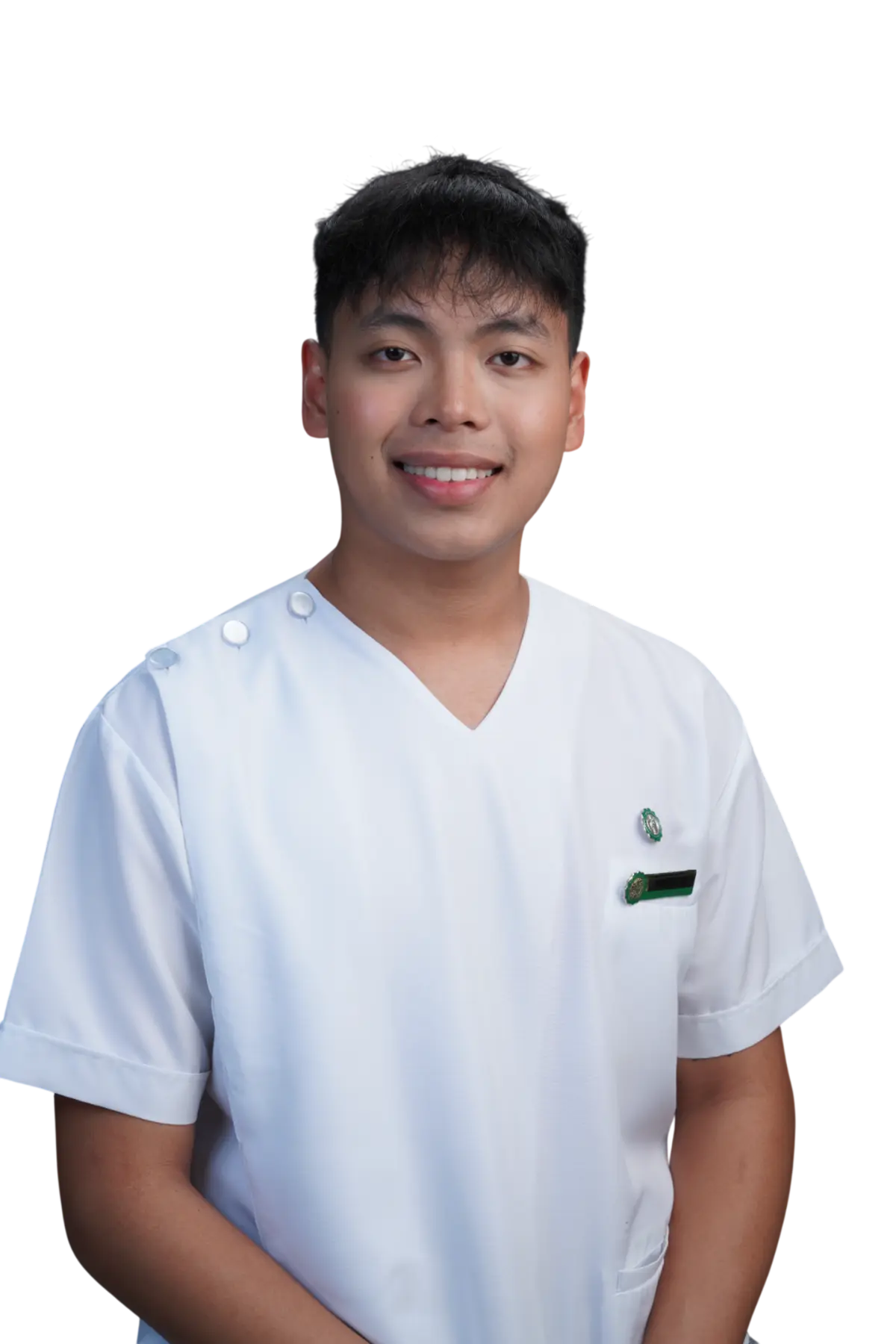
Registered Nurse
Medical Student
From bedside care to clinical inquiry
I am Pio Andrei H. Lojo, a Registered Nurse and first-year medical student dedicated to continuous learning and growth in healthcare.
With a foundation in nursing, I aim to expand my knowledge and skills in medicine while becoming a compassionate, competent, and patient-centered physician. My experience has shown me that careful observation, clear communication, and disciplined teamwork are essential wherever a patient places their trust.
Academic pathway / 02
Each stage built a different part of the discipline I now bring to medical school.
Preschool
Grade School and Junior High School
Senior High School
De La Salle Medical & Health Sciences Institute
Manila Central University College of Medicine, MD-1
Practice / Leadership / 03
Clinical practice
I provided perioperative nursing care, assisted during surgical procedures, maintained sterile technique, and helped protect patient safety throughout the surgical process.
Leadership and service
Active participation in organizational activities, service initiatives, and leadership responsibilities strengthened my communication, teamwork, and ability to guide others with purpose.
Portfolio control / Study phase
Two terms. One evolving understanding.
Learning pathway / 04
Biochemistry challenged me to slow down, revisit the basics, and look beyond memorization. Select any chapter to read the reflection.
I learned that Biochemistry gives medicine its molecular foundation. I initially struggled to connect chemical processes with actual disease, but the discussion helped me see that cellular changes can explain symptoms, guide diagnosis, and influence treatment. Understanding the science beneath a condition will help me care for patients with greater purpose.
I learned how water, buffers, and pH protect the body's internal balance. The calculations and acid-base relationships were difficult for me at first, so I had to review them step by step. This chapter showed me that even a small change in pH can have major clinical consequences.
I learned that the properties of amino acids determine how proteins behave. I struggled with the many structures and classifications, but grouping them by charge, polarity, and side-chain behavior made the information more understandable. Repetition helped me move from memorizing names to recognizing patterns.
I learned that the exact amino acid sequence forms the basis of every protein's identity and function. I found sequencing methods difficult because each step had to be understood in the correct order. Working through the process carefully taught me that precision at the molecular level matters.
I learned how proteins fold into secondary, tertiary, and quaternary structures that make their functions possible. Distinguishing the interactions at each level was challenging, but visualizing the shapes helped me understand why a change in folding can also change health.
I learned how structure allows myoglobin to store oxygen and hemoglobin to transport it. The binding curves and factors that shift oxygen affinity were difficult for me to interpret, but revisiting them helped me connect molecular behavior with the body's changing oxygen needs.
I learned how enzymes lower activation energy and allow essential reactions to proceed efficiently. I struggled to follow the sequence of binding, transition-state stabilization, and product release, but breaking the mechanism into stages made the process clearer.
I learned how Km and Vmax describe enzyme behavior. This was one of the most challenging chapters because I had to understand equations, graphs, and their meaning at the same time. Practice helped me see the graph as a story of how an enzyme responds to changing substrate levels.
I learned that the body regulates enzymes to coordinate metabolism and maintain balance. The different regulatory mechanisms were easy to mix up, so I focused on the purpose of each one. This chapter reminded me that mastery takes patience, repetition, and the willingness to ask why.
Midterms 2026 / My field notes
Transitioning into midterms of first-year medical biochemistry has been one of the most overwhelming experiences of my life. The sheer volume of pathways, enzymes, and clinical correlates often felt like drinking from a firehose. There were countless nights where the material simply wasn't clicking, but my biggest milestone this term was learning to celebrate the little wins. Despite having a really hard time understanding the complex molecular cascades at first, I am so genuinely proud and glad that I can still manage to get a score on our assessments instead of a zero. It proved to me that my effort is working, even if the progress feels slow.
Chapter reflections
I learned how ATP acts as our body’s energy currency, though I struggled to grasp the thermodynamic formulas. It reminds me to "spend" my own daily energy wisely on high-yield study tasks.
I learned the mechanics of redox reactions but had a hard time memorizing the specific oxidases. I apply this now by appreciating the antioxidants in my diet to fight oxidative stress!
I learned how electrons physically generate power, though visualizing the complexes in the inner mitochondrial membrane was tough. It makes me appreciate the simple act of breathing to keep my cells alive.
I learned the vast classification of carbohydrates, but struggled distinguishing epimers and isomers. It has completely changed how I read nutritional labels on my snacks.
I learned why Krebs is the central hub of metabolism, though memorizing every intermediate was a classic med school struggle. It showed me why my body desperately needs a balanced diet to keep the cycle turning.
I learned the "big picture" of how our body routes fuel, but struggled to keep all the intersecting pathways straight. It helps me understand how my body processes my late-night study meals.
I learned how glucose is quickly broken down for energy, but the rate-limiting enzymes were confusing to track. I think about this pathway every time I get a quick sugar rush to run to class.
I learned how our liver stores and mobilizes energy, though the cascading hormonal regulations were tricky. It makes perfect sense now why I need to eat well before a marathon study session.
This was my absolute favorite! I scored 100% on every experiment. Seeing the abstract concepts applied in a virtual lab made everything click and gave me a huge confidence boost.
I learned how we generate NADPH for cellular defense, but struggled with the non-oxidative phase reactions. It’s fascinating to know my cells have a built-in pathway to handle the stress I put them through.
I learned how the body literally makes its own sugar during fasting, though the bypass reactions were heavily detailed. I apply this by understanding exactly how my brain stays fueled when I accidentally skip breakfast during exam week.
From concept to clinical thinking
The SGD "The Silence Inside the Vehicle" was a real eye-opener for me as a first-year medical student. It perfectly bridged our basic biochemistry lectures on hemoglobin with a real-life clinical emergency. Learning how carbon monoxide binds to hemoglobin with over 200 times the affinity of oxygen forming carboxyhemoglobin and shifting the dissociation curve to the left made the molecular concepts finally click. It is terrifying to realize how a silent, odorless gas can so easily hijack the body’s entire oxygen transport system and starve peripheral tissues.
Beyond just memorizing textbook mechanisms, this case highlighted the heavy responsibility we are preparing for. Seeing how a simple competitive inhibition at the molecular level rapidly turns into a fatal clinical scenario emphasized exactly why we need to master these foundations. It was a stark reminder that we aren't just studying pathways to pass our biochemistry exams; we are learning the "why" behind life-saving clinical interventions, like administering 100% oxygen to outcompete the carbon monoxide.
I prepared extensively for our Spectrophotometry report, spending hours making sure I truly understood the Beer-Lambert Law and its clinical applications. Because I was assigned as one of the reporters, I wanted to do my part well. When the format shifted to an online setup, I was honestly quite relieved. As someone who gets nervous presenting in front of a crowd, the virtual format felt like a safe space where I could just focus on delivering the material I had worked so hard to digest.
Unfortunately, my relief turned into pure panic when my microphone completely malfunctioned right as it was my turn to speak. I felt so defeated watching all my preparation go to waste in real-time. More than the frustration of the technical glitch, I felt incredibly anxious and shy toward my groupmates. I was terrified they would think I faked the microphone issue just to get out of reporting, and I felt a heavy sense of guilt for not being able to contribute my voice during the actual presentation despite all the work I put in behind the scenes.
Creating the G6PD deficiency infographic was a refreshing and challenging exercise in science communication. In our lectures, it’s easy to get lost in the intricate details of the Hexose Monophosphate (HMP) shunt and the exact mechanisms of oxidative stress on red blood cells. However, this activity forced us to step back and translate complex biochemical concepts—like Heinz bodies, bite cells, and triggers like fava beans or certain medications—into a visually appealing and easily digestible format. It made me realize that you truly have to master the core pathway before you can simplify it for someone else.
Working with my groupmates made the process much more engaging, as we brainstormed how to balance accurate medical information with a clean, uncrowded design. As a first-year medical student, this was a great reminder that knowing the science is only half the battle; the other half is effectively communicating it. This infographic is exactly the kind of tool we will eventually use in the clinics to explain a diagnosis to a patient or a worried parent. It was a creative break from our heavy textbook reading that ultimately taught me a valuable lesson in empathy and patient education.
Field notes / 05
These photographs hold the places where discipline was tested, teamwork became real, and perspective continued to grow.
Closing reflection / 06
The more I understand the science behind life, the more intentionally I can protect it.
What I Will Carry Forward / 06
Moving into the next term, the most important lesson I am carrying forward is that medical school is about persistence, not perfection. Biochemistry is intimidating, but I’ve realized that if I take it one pathway and one small victory at a time, I can actually understand it. I will carry this newfound resilience and my 100% Labster confidence with me, trusting that every struggle today is just building the foundation for the doctor I will become.
Contact / 07
First-year medical student at Manila Central University College of Medicine.